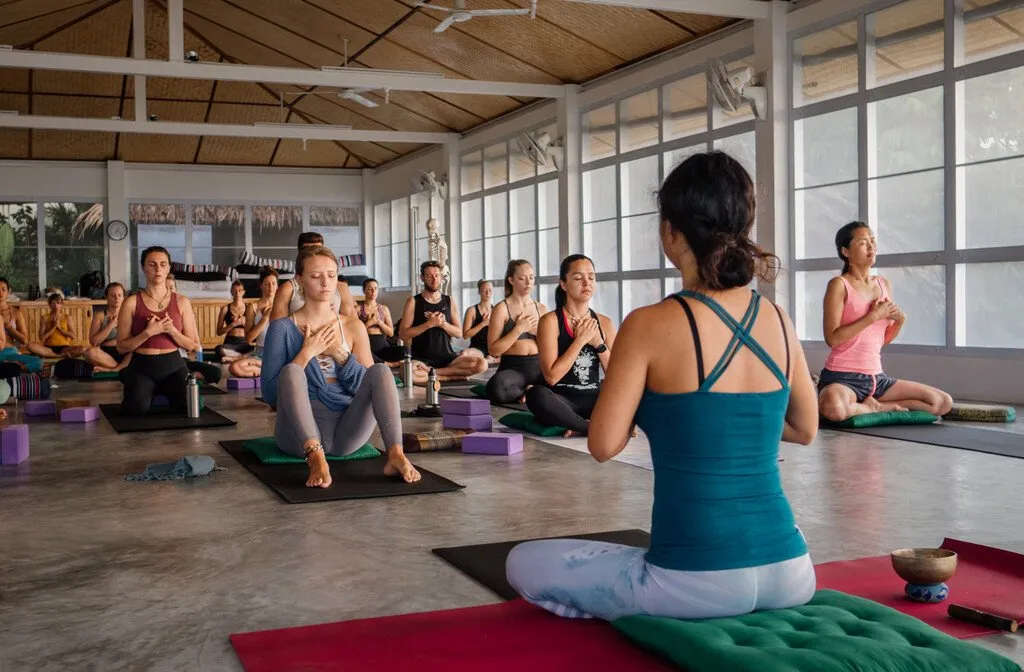
The vast majority of articles written at the intersection of yoga and home life are about creating a home practice space. They recommend rolling out a mat in the corner of your bedroom, lighting a candle, and following an app. This article is about something entirely different. It is about the documented psychological and neurological spillover effect that happens when you attend structured yoga classes near you consistently, and how that spillover gradually and measurably changes the quality of your experience inside your own home.
You do not need to renovate anything, purchase equipment, or designate a room. What changes is not your flat. What changes is you, and the change follows you back through your front door every time you attend class.
When Singaporeans start searching for yoga classes near me and commit to a consistent schedule, the benefits they report extend well beyond physical flexibility or reduced tension at the end of the workday. They describe sleeping better in the same bedroom they have slept in for years. They notice that their evenings feel quieter even when the environment has not changed. They become more deliberate about how they spend time at home, what they eat, when they put their phone down, and how they start the morning. These are not coincidences. They are the predictable outcomes of what consistent yoga practice does to the nervous system, and they are worth understanding explicitly.
The Nervous System Brings the Studio Home
Every time you attend a yoga class, your nervous system undergoes a measurable shift from sympathetic activation, which is the stress-dominant state, into parasympathetic dominance, which is the rest, digest, and recover state. This shift does not happen instantly for most people. In the first few weeks of practice, it may take most of the class to arrive at genuine stillness. But over months of consistent attendance, the transition becomes faster, deeper, and more complete.
What neuroscience shows is that this repeated experience of deep physiological rest creates a conditioned response. The brain associates specific sensory and behavioural cues, the act of arriving at a studio, removing shoes, unrolling a mat, following breath instruction, with the neurological state of recovery. Over time, that association strengthens. The conditioned recovery response begins to activate earlier in the sequence, sometimes just by stepping into the studio, and eventually begins to generalise into environments that share some of those cues.
Your home, over time, begins to share more cues with your recovery state than it used to. Not because you have added anything to it, but because your nervous system’s capacity for recovery has grown, and it begins to express itself in familiar environments.
Sleep: The Most Immediate Home Benefit
The most commonly reported home improvement among consistent yoga practitioners in Singapore is sleep quality. Not the length of sleep, but the depth of it. Falling asleep more easily, waking less frequently, and feeling more rested at the same duration are the specific changes practitioners describe.
The mechanism is well-understood. Chronic stress keeps the sympathetic nervous system partially activated even during the transition to sleep, resulting in lighter sleep stages, more frequent micro-arousals, and reduced time spent in slow-wave and REM sleep. These are the stages responsible for physical recovery, memory consolidation, and emotional regulation.
Consistent yoga practice, particularly formats that include Yin, restorative, or Yoga Nidra, trains the nervous system to make the sympathetic-to-parasympathetic transition more efficiently. As this capacity strengthens from in-person class practice, it begins to apply itself in the bedroom. The same bed that previously felt like a place of anxious wakefulness or poor-quality sleep begins to function more effectively as a recovery environment, not because anything about the bed changed, but because the nervous system arriving in it is different.
For Singaporeans who live in smaller HDB flats where the boundaries between work, screen time, and rest are physically compressed into a single space, this internal shift is particularly valuable. You cannot always change your environment. You can change how your nervous system responds to it.
The Deliberateness Effect
One of the less-discussed outcomes of regular yoga practice is what researchers in habit science call intentional behaviour transfer. Yoga classes involve repeated practice in making conscious, deliberate choices rather than habitual or reactive ones. Choosing where to direct your gaze during a balance pose, choosing to stay with discomfort rather than immediately releasing a stretch, choosing breath over tension in a challenging posture: these are micro-practices in deliberate decision-making.
Over months of consistent practice, this deliberateness begins to show up outside the studio. Practitioners report becoming more selective about how they spend their evenings. Less aimless scrolling, not because they made a resolution about it, but because the pull of passive consumption loses some of its automatic quality. More awareness of when they are actually hungry versus when they are eating out of stress or boredom. More intentional choices about what the home environment sounds like: quieter evenings, less background television as ambient noise, more comfort with silence.
These are not dramatic lifestyle transformations. They are subtle but cumulative shifts in the quality of daily home life that emerge as natural downstream effects of a practice that trains attentional control and present-moment awareness week after week.
Evening Transition: How Yoga Class Rewrites the Work-to-Home Boundary
Singapore’s working culture is characterised by a compressed transition between professional and personal life. Many people leave the office, sit on the MRT checking work messages, arrive home, eat quickly, and then spend the evening in a state that is neither fully working nor fully resting. The nervous system remains in a low-grade activated state, producing the familiar feeling of being tired but unable to properly unwind.
Attending a yoga class after work fundamentally rewrites this transition. The class acts as a physiological buffer, a structured period in which the nervous system is guided from work-mode activation into genuine recovery. By the time you arrive home after an evening class, your cortisol levels are measurably lower, your heart rate variability is higher, your breathing is slower, and your brain is genuinely in a different gear.
The flat you walk into after a yoga class is the same flat you would have walked into directly from the office, but your experience of it is categorically different. Evening meals taste better when the digestive system is in parasympathetic mode. Conversations with family or housemates are more present and less reactive. The ability to sit without immediately reaching for stimulation is noticeably greater. Sleep that follows this transition is deeper.
Over time, the home begins to accumulate the emotional association of recovery rather than the extension of stress. This is one of the most practically meaningful gifts a consistent yoga practice gives back to Singaporean home life, and it costs nothing additional beyond the commitment to show up.
How the Practice Changes the Morning
The impact of consistent yoga class attendance is not limited to evenings. Practitioners who maintain a regular schedule, even if it is exclusively afternoon or evening classes, consistently report changes in their morning experience at home.
Better sleep produces a different quality of waking. Rather than surfacing from fractured, unrestorative sleep into immediate alertness that feels like anxiety, practitioners describe a gradual, more grounded awakening. The morning becomes less reactive. There is more capacity for the small rituals that make a morning feel considered rather than frantic: a proper breakfast, a few minutes without the phone, a clearer mental start to the day.
The posture improvements from yoga practice also change the physical quality of morning experience. Reduced thoracic stiffness means that sitting upright at the breakfast table is comfortable rather than effortful. Reduced hip tightness means that the first steps of the day are easier. These are small things, but they compound into a morning that feels fundamentally more liveable.
For Singaporeans in Small Flats
Singapore’s housing reality means that the average residential space is significantly smaller than most Western countries. HDB flats, particularly two-room and three-room units, require the same space to function as bedroom, workspace, dining room, and living room simultaneously. This compression of function into limited space makes the internal quality of rest more important, not less, because the environmental cues for work, stress, and recovery are all physically present in the same room.
This is precisely why developing a robust internal capacity for recovery through in-person yoga classes is so relevant to the Singaporean home context. You cannot always separate your work desk from your sleeping space. But you can develop a nervous system that, after months of practice, knows how to find rest even in an environment that contains work cues.
The studio becomes a dedicated recovery environment that your home, through the spillover effect described throughout this article, gradually begins to approximate not physically, but experientially.
Yoga Edition operates studios at Millenia Walk, Novena, and CIMB Plaza in Raffles Place, offering convenient access points for practitioners across different parts of Singapore to build and maintain the consistent class schedule that produces the home life benefits described here.
Frequently Asked Questions
Q. Do I need to do anything specific at home to reinforce the benefits of my yoga classes?
A. No specific home practice is required to experience the spillover benefits described in this article. The changes described are downstream effects of consistent class attendance rather than deliberate home interventions. If you wish to reinforce the practice, simple breathwork or a few minutes of stillness before bed can complement class attendance, but it is not a prerequisite.
Q. How many classes per week are needed to notice changes in sleep quality at home?
A. Most practitioners report noticeable improvements in sleep quality within three to four weeks of attending two to three classes per week. The changes are cumulative, with deeper and more consistent improvements developing over two to three months of regular attendance.
Q. My home environment is noisy and stressful. Can yoga classes still help?
A. Yes. The benefit described in this article is an internal shift in how your nervous system responds to your environment, rather than a change in the environment itself. A quieter nervous system navigates a noisy environment more effectively. Many Singaporeans in demanding household situations report that yoga classes are one of the few tools that genuinely reduce their reactivity to domestic stress.
Q. I share a flat with housemates and have very little personal space. How does this affect things?
A. The studio environment provides the dedicated personal space and recovery time that your home may not offer. For practitioners in shared living situations, this can be one of the most practically important benefits of attending classes. The practice becomes the space, not the physical room.
Q. Will my family or housemates notice a difference in me after I start attending regular yoga classes?
A. This is one of the most commonly reported experiences among consistent practitioners. Partners, family members, and housemates frequently comment on reduced reactivity, greater patience, and a calmer presence, particularly in the evenings. These are natural consequences of the nervous system changes produced by regular practice rather than deliberate behavioural changes.
Q. Is there a particular time of day to attend yoga classes that produces the greatest benefit for home life quality?
A. Evening classes produce the most immediate and noticeable benefit for the home environment because they intercept the work-to-home transition directly. Morning classes set a lower stress baseline for the entire day, which also benefits home life quality in the evening. Both are valuable, and many practitioners find that one evening class and one weekend morning class per week produces meaningful improvement in their home experience.